Rome Leadership Retreats, Planned and Run End to End
Your CEO mentioned Italy. Now it is on your desk, on top of everything else, and the first thing anyone will ask you is what it costs and whether the dates work. Book a discovery call and you will have both answers today, in a form you can forward.
What a Rome leadership retreat involves
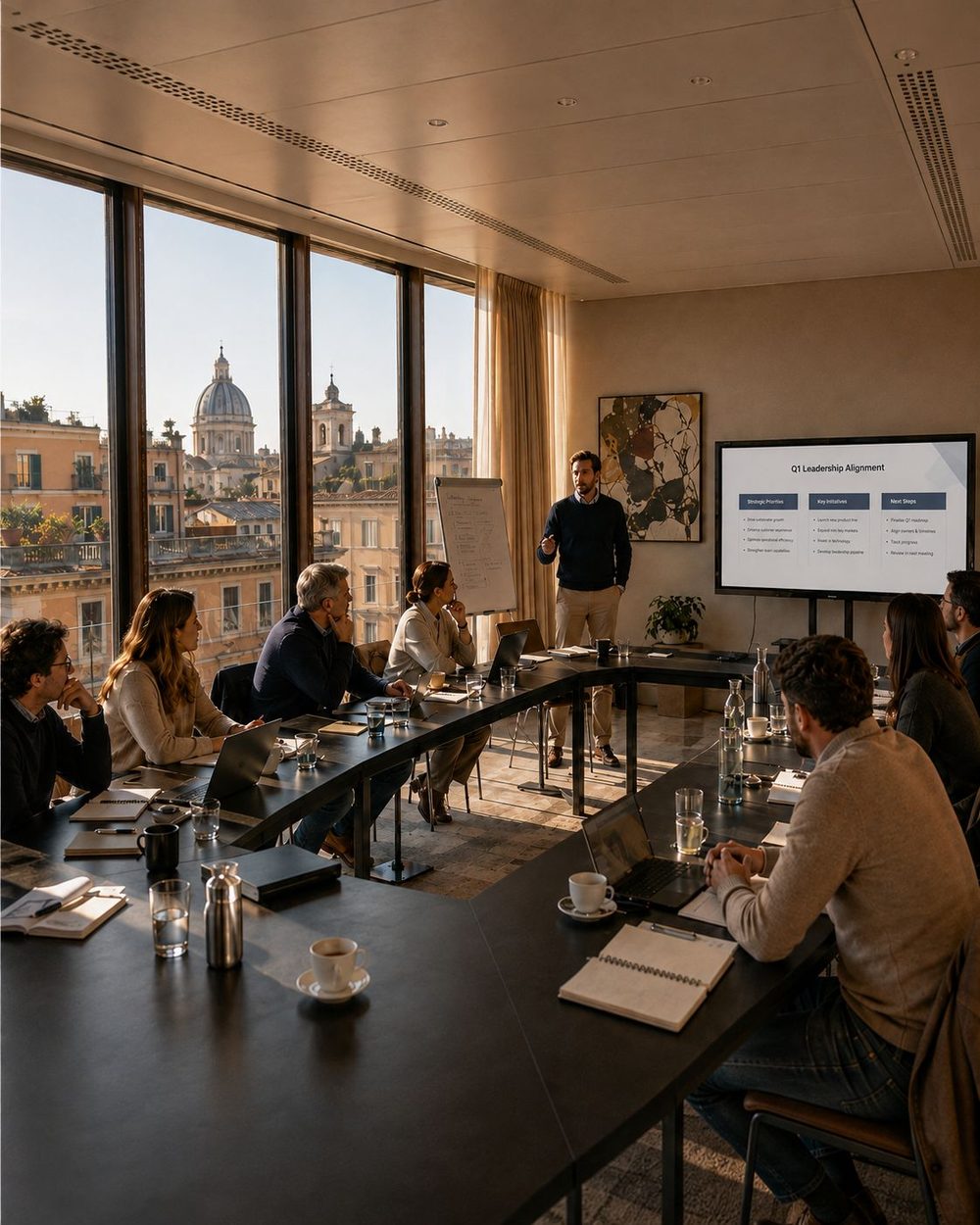
A Rome leadership retreat is a two or three day working session for a senior team, held in a central hotel with a private meeting room and built around a cultural programme in the evenings. A typical three day format for 10 to 20 people delivers around 12 hours of structured working time, two dinners, one guided experience and one free evening. Italiaplus plans the programme, coordinates every Italian supplier and runs it on the ground, so the person organising it can take part in it.
You did not ask for this project
Why does an Italy offsite always land on one person's desk?
It usually starts with a sentence. Someone in leadership says the team should get together somewhere in Italy, and the sentence contains no dates, no budget and no headcount. Then it becomes your project, alongside the job you already have.
What follows is familiar. You open 15 hotel websites and none of them will tell you whether their meeting room actually seats your group in a U-shape. You ask three suppliers for quotations and get three formats back, one of which is in Italian. You cannot answer the only two questions leadership will ask, which are what it costs and whether it can happen on those dates, so the project sits open in your head for a fortnight.
And the questions arrive faster than the answers. Does the meeting room seat 14 in a U-shape, or only theatre style? Who needs a single room? Is the coffee station included in the room rental or charged per person? What happens if two people arrive a day late? Does that quotation include Italian VAT or not? Who tells the restaurant about the two vegetarians and the severe nut allergy?
Every one of those is answerable in a morning by someone who does this every week. It takes a fortnight for someone who does not.
None of that is a research problem. It is a structure problem, and it is the reason the first call is worth more than the first proposal.
We do this every week. You do not have to carry an Italy retreat alone, and you should not have to become an expert in Roman meeting rooms to get one approved.
The first call
What do you actually get from a discovery call?
Not a brochure, and not a venue list. Within one working day of the call you receive a single page you can forward to your CEO without rewriting it. It contains four things.
-
A realistic per person range for your dates
This is not a brochure price but a range built on your headcount, your rooming assumption and what central Rome actually costs in the month you are considering, with Italian VAT stated explicitly rather than buried.
-
A yes or a no on feasibility
Whether a meeting room for your group exists on those dates, or whether you need to move by a week. Finding that out in the first call rather than the third week is the single biggest time saving we offer.
-
The two or three decisions leadership needs to make
Usually dates, headcount and whether single rooms are assumed. Everything else can wait. You go back to your CEO with specific questions rather than an open one.
-
The date by which you need an answer
Rooms and meeting space are held on option for a limited window. We give you the deadline in writing so you can put a real date in the internal conversation instead of chasing it.
If Rome turns out to be wrong for what your leadership actually wants, we will say so on the call and point you somewhere better in Italy. That costs you 30 minutes and saves you a month.
Common at this stage, and all fine: you do not have firm dates, you do not know the budget, leadership has not approved anything, or you are gathering options for comparison. Every one of those is a normal starting point.
Transparent scope
What do we take over, and what stays with you?
The most common reason an offsite becomes a second job is that nobody agreed this at the start. So we put it in writing before you commit to anything.
| Italiaplus handles | Stays with you |
|---|---|
|
|
Scroll to see the full table
If you would rather keep part of the operational side in-house, say so at the briefing. We can scope modules rather than the whole programme, and we will price them separately so the comparison is clean.
Not another venue list
Is Rome actually the right city, or just an appealing one?
Rome is one of the strongest executive offsite cities in Europe for groups of 10 to 200. It is a poor choice for a 600-person conference, and you should know why before you propose it internally.
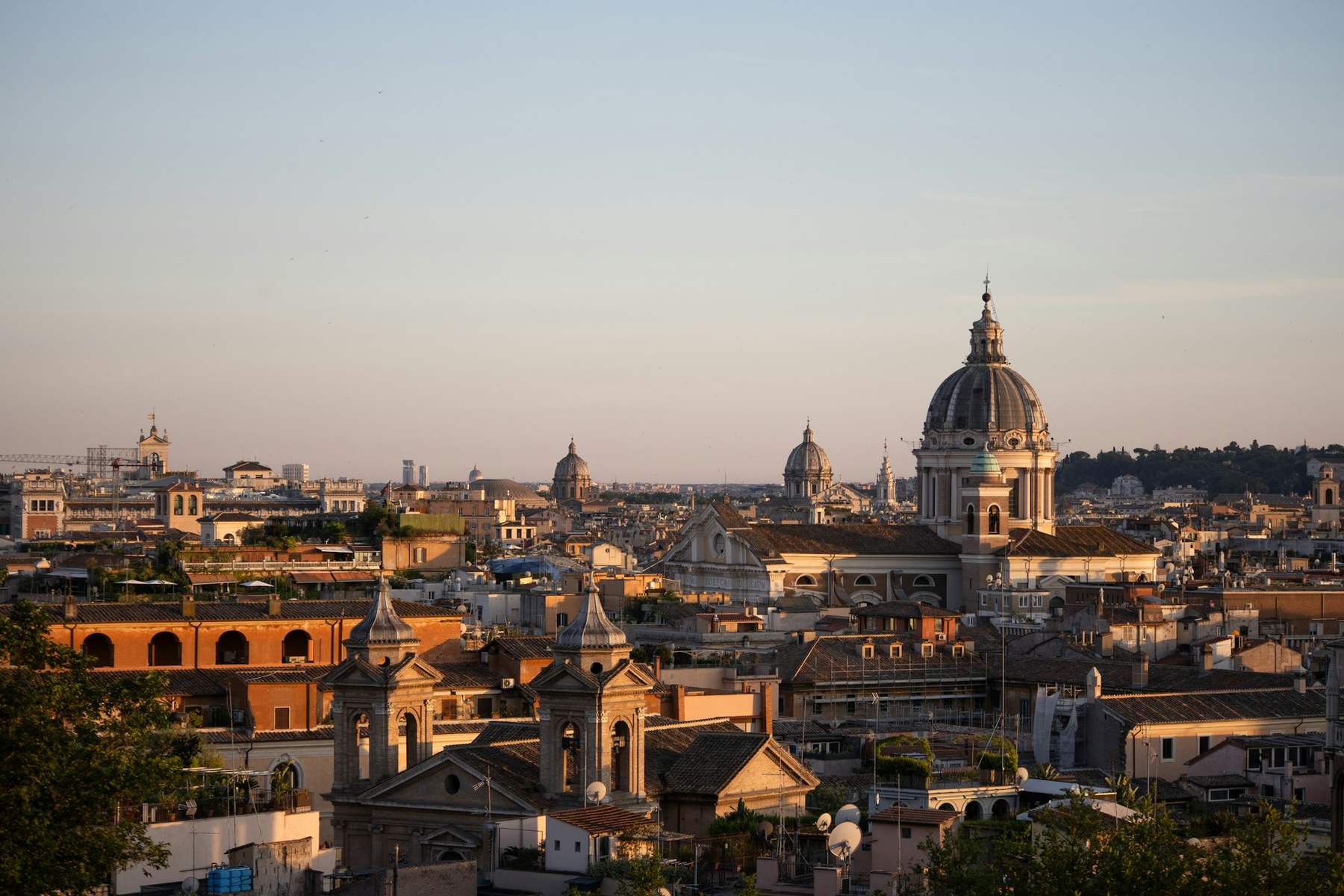
The meeting infrastructure sits inside historic buildings on narrow streets, which caps room sizes and complicates coach access. What you get in exchange is a 5-minute walk from your closing session to a 2,000-year-old monument, which is not a detail a purpose-built conference hotel can match.
The city divides into three corridors for corporate work. The historic centre and Via Veneto hold the premium hotels in historic buildings, which is where leadership retreats belong. EUR, the modern business district to the south, offers larger and more conventional meeting space. Parioli and Flaminio are quieter and residential.
The argument that usually wins internally is connectivity. Fiumicino has direct links to most European business hubs, so a team arriving from four countries can converge inside a single morning. That is what makes an 11:00 start on day one realistic, and it is worth putting in your internal note.
Business logic first
How should three days in Rome be structured?
The allocation used across executive retreats is roughly 60% to 70% structured strategic work, 20% to 25% relationship building, and 10% to 15% breaks and personal time. Working blocks run 90 to 120 minutes with 15-minute breaks, and most well-built agendas include a free block of 60 to 90 minutes in the late afternoon so people can take calls before the evening.
On that basis a two day retreat yields about 12 to 14 hours of working time and a three day format reaches 16 to 20. A Rome programme usually lands near the lower end of the three day range, around 12 hours, because the cultural programme is doing real work rather than filling space.
Two failure modes are worth naming, because your leadership will recognise both. If the agenda is mostly presentations, you have organised a conference rather than a retreat, and senior people do not need more information delivered at them. And if the group leaves energised but unclear about what changes on Monday, the momentum dissipates within a month or two. That is why the closing segment matters more than the opening one.
We do not write your content. We build the days around it, and we will tell you if the shape you have described does not fit the hours available. That conversation is easier before the dates are booked.
A three day Rome retreat, hour by hour
Forwardable as it stands. This is the shape we would start from and adapt to your content.
| Day | Working sessions | Evening | Why it sits there |
|---|---|---|---|
| Day 1 | Late start at 11:00 so people can fly in that morning. Opening and framing, one 75-minute workshop, lunch, then an afternoon block of up to 2.5 hours. | Hands-on cultural experience from late afternoon into an early dinner, then an open rooftop. | The group is together within an hour of the first session ending, before anyone has drifted back to email. |
| Day 2 | The heaviest day. A 2-hour leadership session, a 75-minute preparation block, then a long working or hackathon block through the afternoon with a coffee break inside it. | Guided walk through the centre at 17:30, dinner at 19:30 at one table. | Day 2 carries the deep work because the group has settled and departure is not yet in view. |
| Day 3 | A short morning only. One preparation block and a 30-minute closing segment that confirms decisions, owners and timelines before anyone leaves. | None. Checkout by midday. | A retreat that ends without a closing segment produces alignment nobody wrote down. |
Scroll to see the full table
The detail nobody warns you about
What should you check in a Rome meeting room before you commit?
A U-shape for 10 to 20 people is what lets everyone see everyone, which is the point of bringing them. It needs more floor area than a boardroom set for the same number, and in Rome's historic buildings that combination is scarcer than the room count suggests. A hotel that says it can host 20 may mean theatre style.
There are four questions worth asking in writing. Does the room have natural light, because 3 days without a window changes the mood by the second afternoon. What is included in the rental: screen, beamer, microphone, flipchart, and whether the permanent coffee station comes with the room or is billed per person. Can the hotel seat your group for lunch somewhere other than the meeting room, ideally outdoors. And what happens if it rains, because a rooftop lunch needs an alternative.
Then there are the details that only surface on the day. Some properties require a card pre-authorisation for equipment such as a laser pointer, released when it is returned. It is trivial in isolation. It is less trivial at 10:55 on day 1, when it is you standing at reception.
We confirm every one of these in writing before the proposal reaches you, which means you are never the person discovering them.
The half people remember
What do you do with the evenings?
This is where a Rome retreat earns its budget, and where most self-organised offsites fall back on three tables at a restaurant near the hotel.
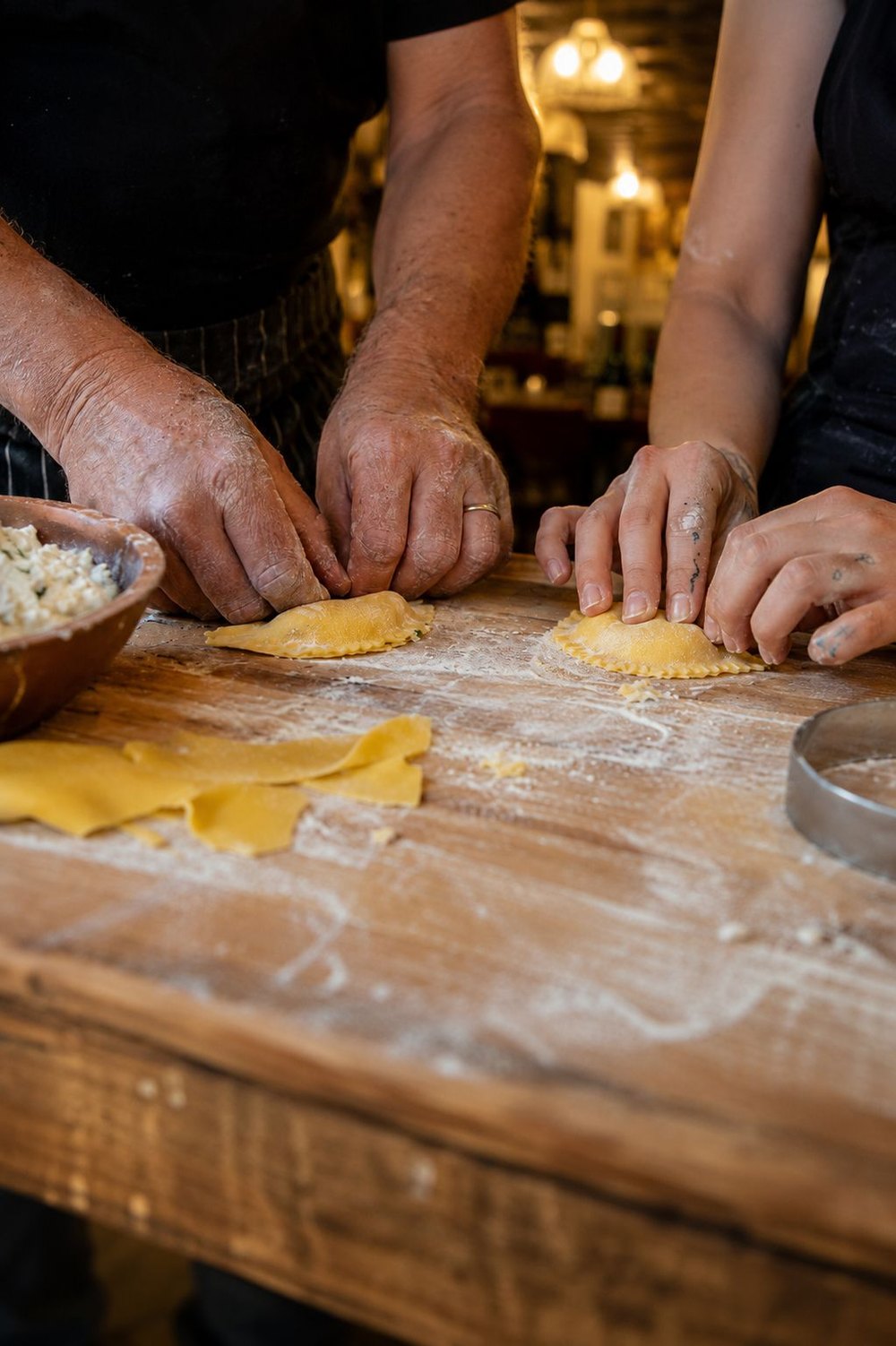
For a first evening, a hands-on experience works better than a meal. A private pasta-making session with a Roman home cook, held in a historic restaurant a few minutes from the Pantheon, runs about 2.5 to 3 hours and finishes as dinner. People who spent the afternoon disagreeing about strategy end up making ravioli badly, side by side, and the next morning's session starts differently because of it.
Timing is the part that gets missed. Starting at around 16:00 gets you a restaurant that is otherwise empty and can therefore be exclusively yours, and puts the group at the table by early evening rather than at 21:00. The same experience booked at 19:00 is a different and worse evening.
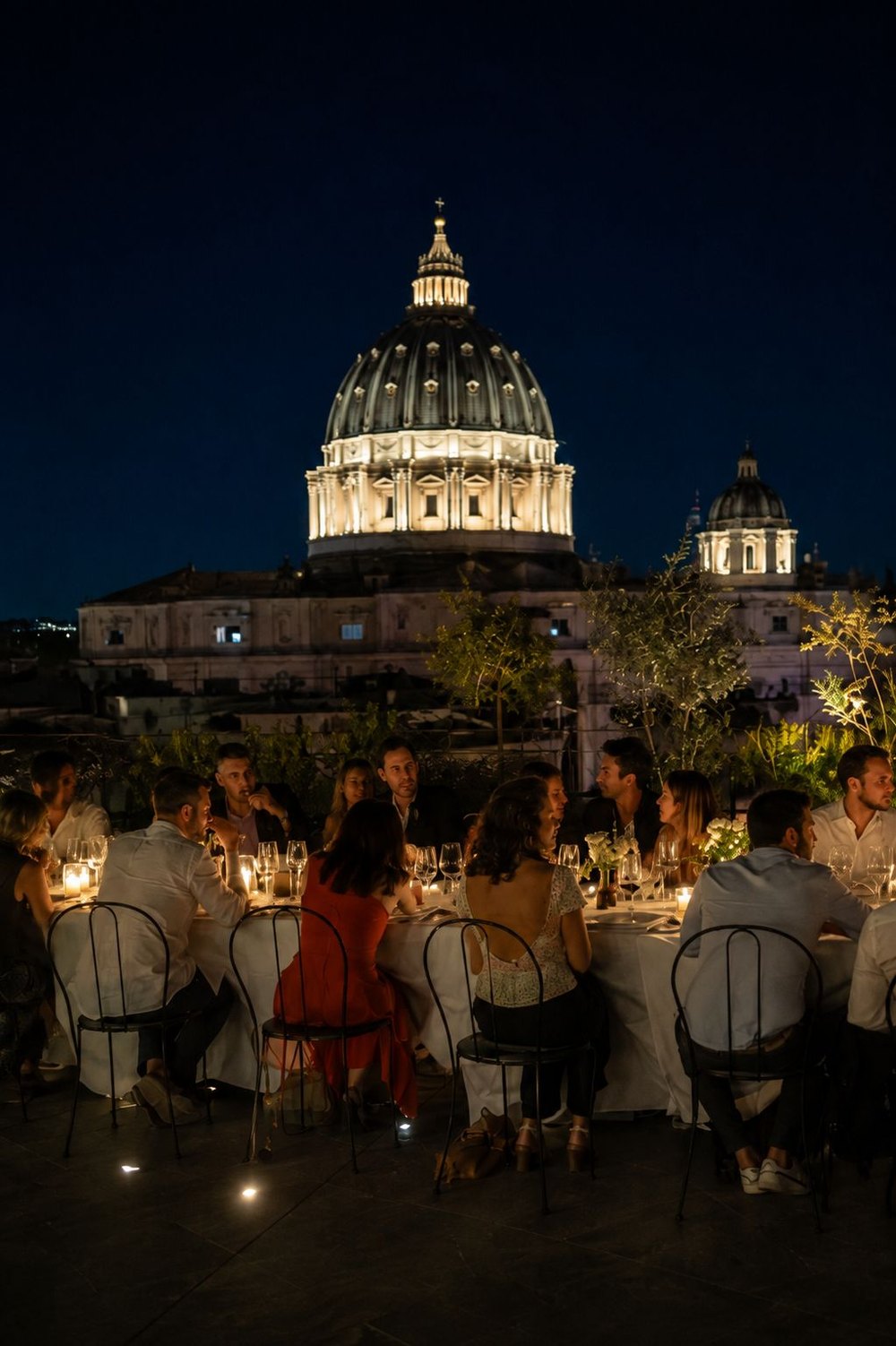
A second evening usually works better as a guided walk into dinner: 90 minutes on foot through the centre, ending at the restaurant. The third evening, if there is one, is best left free. Senior people need one evening they are not scheduled into.
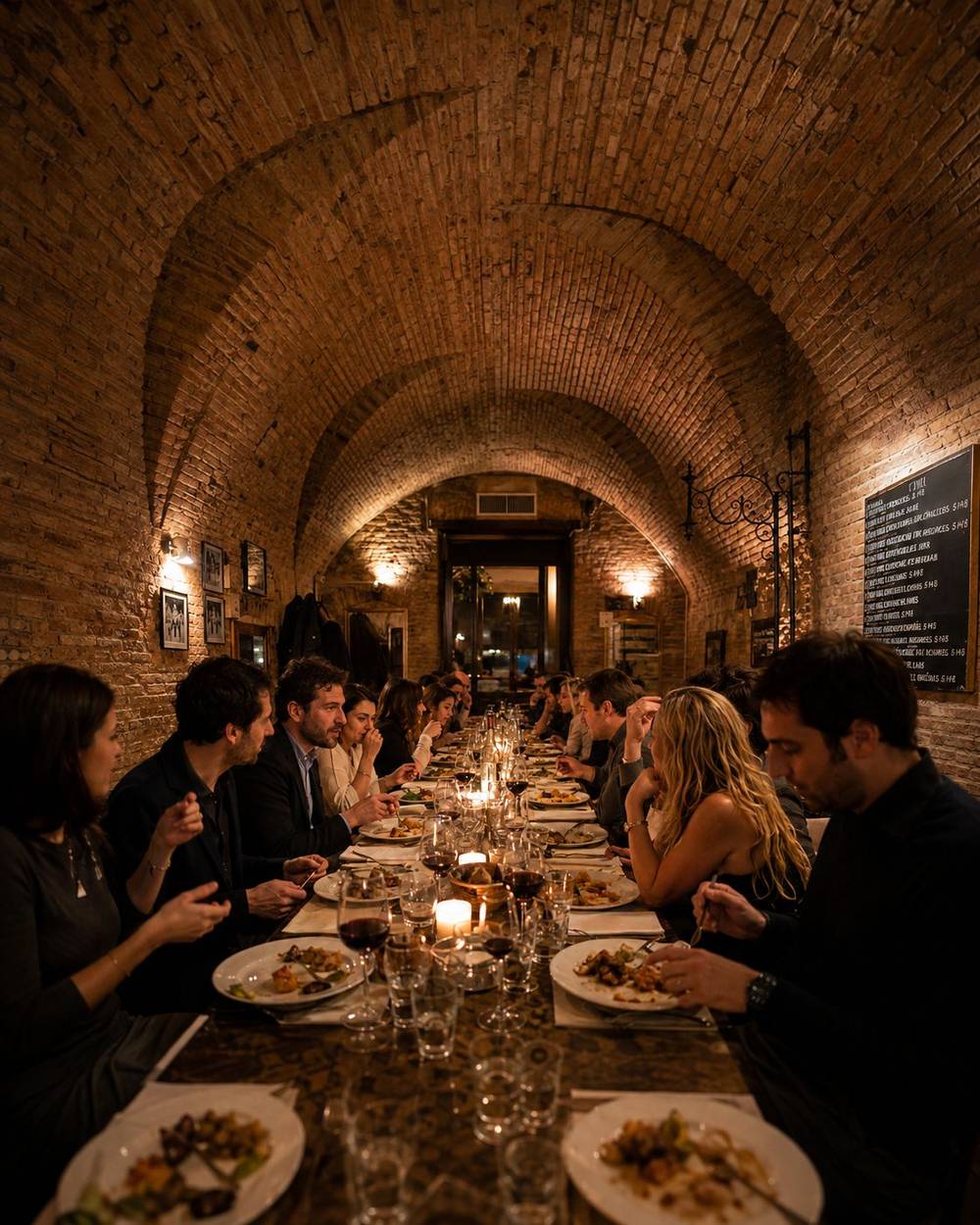
One table matters more than the venue. A group of 16 split across three tables has three separate conversations and no shared reference afterwards, and that is a booking instruction, not a preference.
No open loops
What is included, and what is not?
| Typically included | Typically not included |
|---|---|
|
|
Scroll to see the full table
Budget clarity
What drives the cost, and what will your CFO ask about?
Four things move the number, in roughly this order.
Accommodation is the largest line and the most volatile. Central Rome 4-star properties generally sit between about 220 and 420 euro per room per night, and 5-star properties between about 320 and 640, before seasonality. Senior teams usually expect single occupancy, so your room count equals your headcount rather than half of it. This is the single assumption most worth confirming before anyone quotes you.
Meeting space is charged per full day and per half day, and a U-shape costs more than a boardroom because it needs a bigger room. Food and beverage is the line most often underestimated: three working lunches, two group dinners and a hands-on experience add up faster than the room rate. The evening programme is where scope moves most, and where you have the most control if the number comes back high.
A common planning split for a multi-day corporate event is roughly 30% to 40% venue, 20% to 25% catering, 10% to 15% audiovisual and production, 15% to 20% travel and accommodation, and a contingency of 10% to 15%. A Rome retreat skews further toward accommodation and food than that generic split suggests, and it is worth saying so internally before someone benchmarks you against it.
The question that catches most people is VAT. Italian VAT runs at 10% on accommodation and 22% on most other services. A quotation that does not state whether it is inclusive can be materially wrong, and finding that out during approval is unpleasant. Ours states it explicitly, and you should ask anyone else for the same.
We build every programme to a stated per person budget and tell you on the first call whether your figure and your intentions fit together. If you do not have a figure yet, that is normal and we will give you a realistic range to take back.
When to go, and how far ahead to book
| Period | Verdict | What to expect |
|---|---|---|
| Mid-January, late February, November | Best value | Soft weeks in the Rome calendar. Better rates, better availability, and a city that is not working around you. |
| First half of July | Good | Workable before the Italian summer shutdown, with long evenings for rooftop programming. |
| Easter and Holy Week | Avoid | The centre fills with pilgrims. Rates spike and moving a group on foot becomes slow. |
| August | Avoid | The city empties, many restaurants and venues close, and hotels run reduced service. |
| Christmas week | Avoid | Limited venue availability and staff shortages across suppliers. |
| Jubilee years | Plan around | 2025 drew an estimated 30 to 35 million visitors against 24.8 million in 2024. The next major Jubilee is 2033, so 2026 to 2032 is comparatively clear. |
| Booking lead time | 3 to 6 months | General guidance puts events under 40 people at 4 to 12 weeks. For 10 to 20 people in central Rome we recommend the longer end, because the constraint is not bedrooms but the right meeting room on your exact dates. |
Scroll to see the full table
Rome hotel rates were forecast to rise 7% to 11% through 2026 against 12% to 15% higher booking demand, so an early decision is worth more than it was two years ago. If your dates are inside 3 months, tell us on the call and we will say honestly whether it is still workable.
Risk you will never see
What does an operator in Italy catch that you cannot from a desk?
The decisions that make a retreat work are local, and most are invisible from Frankfurt, London or Zurich. These are the ones that would otherwise become your problem, on the day, in front of the group.
-
A room listed for 20 is not always a room that seats 20
Capacity charts assume theatre style. We check the U-shape set-up, the sightlines to the screen and the light before the room enters a proposal, so you are not rearranging furniture at 10:45.
-
Evening timings are set around the venue, not the clock
An experience starting at 16:00 gets you a restaurant that is otherwise empty and therefore exclusively yours. At 19:00 it does not. That single scheduling decision is worth more than the price difference between two venues.
-
One table is specified in writing, not assumed
Group dinners are booked as a single table for the full headcount and confirmed in the contract, because a restaurant that says yes to 16 sometimes means three tables of five or six.
-
Language is handled where it matters
Where an experience is led by someone working in Italian, an English-speaking assistant translates throughout. It is the difference between an activity your team watches and one they take part in.
-
Dietary requirements reach the kitchen, not just the file
Requirements are passed to every venue in writing, with a vegetarian alternative built into each menu as standard rather than improvised on the night. Serious allergies go directly to the chef.
-
Someone answers the phone while you are in the room
You get a full programme document with addresses, contacts and timings, and one person at Italiaplus who knows your group and is reachable while the retreat is running.
Clear next steps
How does the process work from here?
-
1
The discovery call.
You bring whatever you have, including nothing. We ask the questions that determine feasibility: headcount, a date window, working days needed and what leadership wants out of it.
-
2
Your forwardable summary, within one working day
One page: the shape, a per person range, the decisions leadership needs to make and the date by which you need them. It is written to be sent internally, without you having to rewrite it.
-
3
The proposal, once dates and headcount are confirmed
An hour by hour programme, a clear inclusion and exclusion list, transparent assumptions and a per person price based on your confirmed rooming.
-
4
We hold and confirm
Rooms and meeting space go on option with a written deadline you can quote internally. A deposit confirms the booking, with the balance on a schedule set out in the proposal.
-
5
We run it, and you attend it
The full programme document reaches you before departure. During the retreat you are a participant, and the supplier calls come to us.
Book the call
Ready to take this off your desk?
The call takes 15-30 minutes and needs no preparation. You leave with a per person range, a yes or no on your dates, and a single page you can forward to your CEO the same afternoon.
If Rome is the wrong answer for what your leadership actually wants, we will tell you on the call. We would rather lose an enquiry than deliver a retreat that does not land.
We reply to every enquiry personally. Your details are used to prepare your summary and are not shared with anyone outside Italiaplus.
FAQ
What do organisers ask before they book the call?
Can you just send me a few ideas first?
We can, and it rarely helps. Ideas sent without knowing your dates, headcount and budget are guesses, and you would then have to check each one for feasibility yourself. The 30-minute call replaces that with a single page that has already been checked. If you genuinely only want inspiration at this stage, say so and we will send something short rather than a proposal.
I need to ask my CEO first. What can I send them?
This is exactly what the call is designed to produce. Within one working day you receive a one-page summary written to be forwarded without editing: the shape of the retreat, a realistic per person range, the specific decisions leadership needs to make, and the deadline for making them. Most people find it easier to get approval for two named decisions than for an open question.
We do not know our budget yet. Is the call still useful?
It is more useful then, not less. Most first contacts do not have a figure, and half the reason for the call is to give you one to take back. We will tell you what a retreat of your size and shape realistically costs in central Rome for your month, with Italian VAT stated, so you can open the internal conversation with a number instead of asking for one.
Management has not confirmed dates. Should we wait?
No, and waiting is usually what costs the good dates. Give us a window rather than fixed dates and we will tell you which weeks in it are realistic and which are not. Knowing that Holy Week is unworkable, or that your preferred week already has no suitable meeting room, is the kind of thing better discovered now than after leadership has agreed to it.
We need several quotations for comparison. Is that a problem?
Not at all, and we would expect it for a spend of this size. What we would ask is that you compare like with like: confirm whether each quotation is VAT inclusive, whether the meeting room coffee station is included or per person, and whether single occupancy is assumed. Those three variables move a total more than headline rates do, and they are where comparisons usually go wrong.
How many people is a leadership retreat usually?
Most sit between 10 and 15, which is the size where a single U-shape works, one guide covers the group and restaurants can seat everyone at one table. We plan up to about 200 in Rome, but above roughly 25 some sites need splitting into sub-groups with extra guides, and the number of hotels that can hold one U-shape narrows quickly.
How many days should it run?
Three days including travel is the most common shape, giving around 12 hours of structured working time across a late first day, a full second day and a short third morning. Two days works if everyone can arrive the night before, but it compresses the closing segment, which is the part most often sacrificed and least worth losing.
Do you facilitate the sessions or provide speakers?
No, and that is deliberate. Content, facilitation and external speakers stay with you, because they belong to your business rather than to a travel partner. We build the container: the room, the timings, the breaks, the catering and the evenings. If you want a facilitator we can point you toward people working in Rome, and we do not mark up their fee.
Can we handle some parts ourselves?
Yes. Some teams keep flights and internal communication in-house and hand over everything on the ground. Others want the meeting room and catering handled but book their own dinners. Tell us at the briefing which modules you want and we will price them separately, so the internal comparison stays clean and nobody is paying twice for the same coordination.
Do we need single rooms for everyone?
For a senior team, assume yes. Single occupancy is the norm for leadership retreats, which means your room count matches your headcount rather than half of it. It is the largest single driver of the per person figure, so confirm it before anyone quotes you rather than discovering it at proposal stage.
What happens if our headcount changes after we book?
It usually does, and we plan for it. Hotels typically allow a room block to flex within limits up to a defined date, and we give you that date in writing so you can set an internal deadline against it. Meeting room and catering numbers are confirmed later than bedrooms. Changes affect the per person price, so we reissue it at each confirmed number rather than estimating.
Can different entities or cost centres be invoiced separately?
Yes. We can split invoicing across entities or cost centres for a single booking, which matters when a retreat is shared between a holding company and an operating subsidiary, or when one participant group is billed elsewhere. Tell us the split at proposal stage so it is set up correctly from the start rather than corrected afterwards.
Can attendees extend their stay privately?
Yes, and it is worth offering. We can arrange extra nights at or near the group rate where the hotel allows it, billed to the individual rather than the company. For a team flying in from several countries, a weekend either side is often what turns an obligation into something people actually want to attend.
How do you handle dietary requirements and allergies?
We collect them at confirmation and pass them to every venue in writing, with a vegetarian alternative built into each menu as standard rather than arranged on the night. Serious allergies go directly to the kitchen. Italian venues handle this well, but only when told in advance, which is precisely the kind of detail that becomes your problem if nobody owns it.
Can we combine the retreat with client meetings in Rome?
Yes, and it is a common reason for choosing a capital over a resort. We can hold the meeting room for a half day, arrange a separate space for external meetings and schedule transfers around them. Mention it at the briefing, because it changes which hotel makes sense and which district you should be in.
What if Rome turns out to be the wrong choice?
We will tell you on the call. Rome suits programmes where the cultural element does real work and the group is between 10 and 200. If your priority is seclusion, a large plenary or outdoor activity, another part of Italy will serve you better, and we plan those too. You are not obliged to arrive at Rome just because you started there.
Who you are contracting with
About ItaliaPlus
-
A German company operating in Italy
Italiaplus Travel & Events GmbH is registered in Wiesbaden and contracts under German law, while planning and delivery happen on the ground in Italy. For a German or Austrian finance department, that combination removes most of the friction from a cross-border booking.
-
Member of VDVO Germany
Italiaplus is a member of the VDVO, the German Association of Event Organizers.
-
Documentation written to be forwarded
Proposals state assumptions, inclusions, exclusions and VAT treatment explicitly, so the person who has to defend the spend internally is not translating a travel document into business language first.
Some images on this page are digitally rendered visualizations and may not depict real people, places, properties, or events exactly as they exist. Programme details are illustrative and are confirmed individually for each group.