There is a familiar pattern many CEOs recognize.
The team leaves the office. The setting is beautiful. The agenda is full, but relaxed. Conversations open up. There is laughter, a sense of relief, a feeling that something important is happening. Soon, everyone returns.
Within weeks, sometimes days, the old dynamics reappear. Decisions slow down again. Priorities blur. Alignment fades. The offsite becomes a memory rather than a turning point.
This is not because offsites do not work.
It is because most offsites are designed to create a mood, not an outcome.
Why executive offsites in Italy are being rethought
Executive teams are operating under a different kind of pressure than even a few years ago.
Hybrid structures stretch attention. Decision cycles are fragmented. Trust is harder to maintain when interaction is mostly transactional. At the same time, expectations on leadership have increased. Teams look for clarity, direction, and meaning, not just targets.
In this context, the classic offsite model feels increasingly insufficient.
A change of scenery alone does not resolve structural tension. A motivational speaker does not replace hard alignment work. And a packed agenda of activities does not automatically lead to better decisions.
Italy enters this conversation not as an escape, but as a working environment.
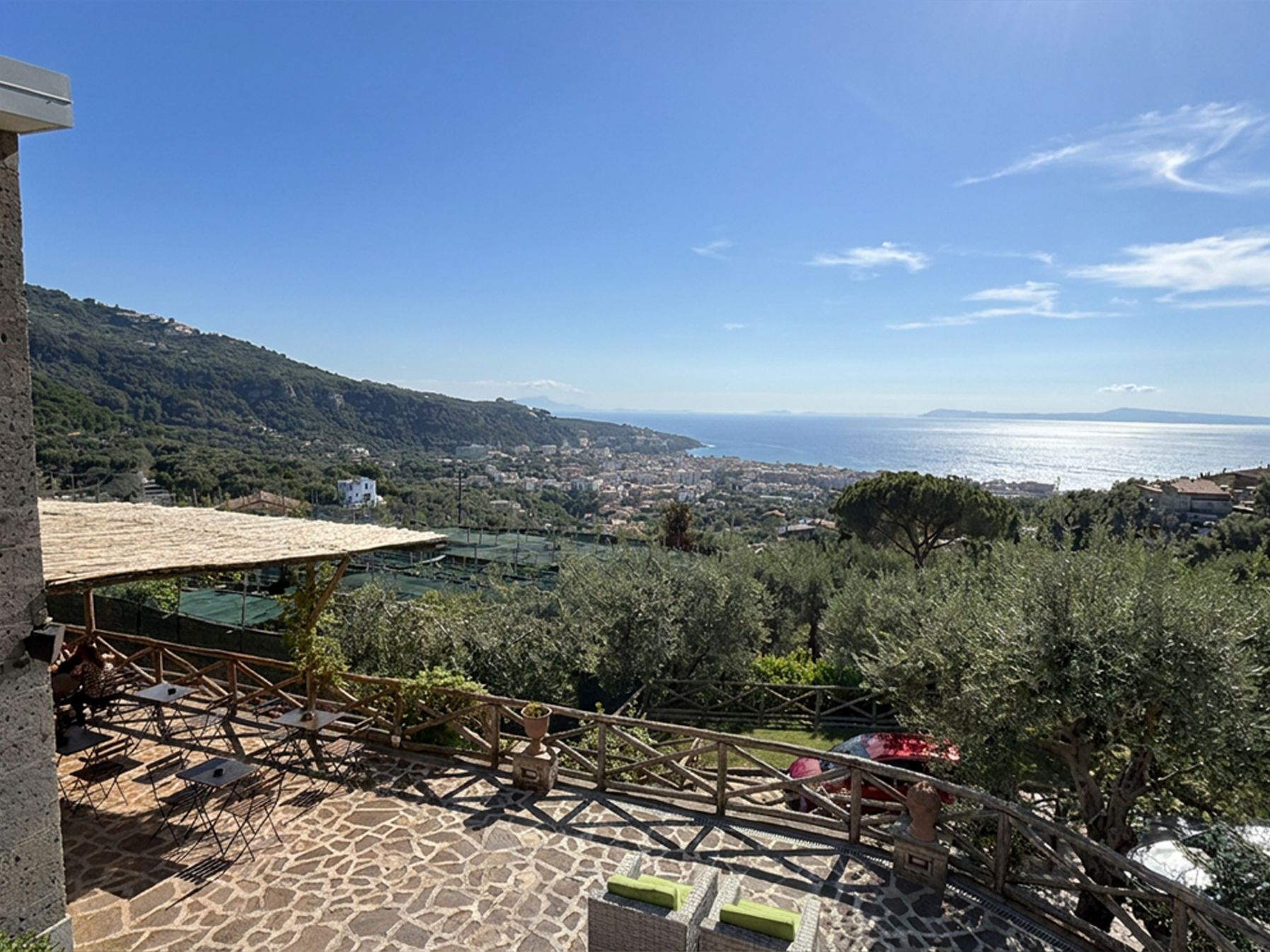
Its geography, rhythm, and cultural relationship with time create conditions that are difficult to replicate elsewhere. A hillside outside Florence, a restored masseria in Puglia, or a discreet palazzo in Rome does not distract from work. It slows it down just enough to make it sharper.
This is why searches for executive offsites in Italy have shifted in intent. Leaders aren’t just seeking something impressive, they’re seeking something that actually works.
The real problem with most offsites
Most offsites fail quietly. They do not collapse. They do not cause visible harm. They simply do not change anything fundamental.
The reason is rarely logistics or effort. It is design.
Many offsites are built around assumptions that feel reasonable, but are rarely examined. That time together automatically creates alignment. That open discussion leads to clarity. That inspiration leads to action.
In reality, behavior doesn’t change because people talked. It changes when conditions are created that make different decisions possible.
Without a clear outcome logic, offsites default to comfort. Familiar voices dominate. Difficult topics are postponed. The agenda fills itself with safe discussions and agreeable conclusions.
What feels like progress during the offsite often turns out to be relief from pressure. Eventually, that relief fades.
What outcome-driven retreat design actually means
An outcome-driven executive offsite starts with a different question. You don’t ask, “Where should we go?” but rather, “What must be different after we return?” This shift sounds simple yet it is not.
It requires defining the few decisions, behaviors, or alignments that truly matter. Not ten themes. Not a vision statement. But the specific shifts that would make the leadership team more effective.
Examples are rarely abstract.
Clearer decision rights between CEO and leadership team. A shared stance on strategic trade-offs. A reset of trust after growth or conflict. A redefinition of roles that reflects reality rather than org charts.
Once these outcomes are explicit, everything else follows.
The location is chosen to support the work, not to entertain. The structure creates space for depth, not distraction. Facilitation is designed to surface what is usually avoided, not to smooth it over.
Italy is particularly effective here because it resists acceleration.
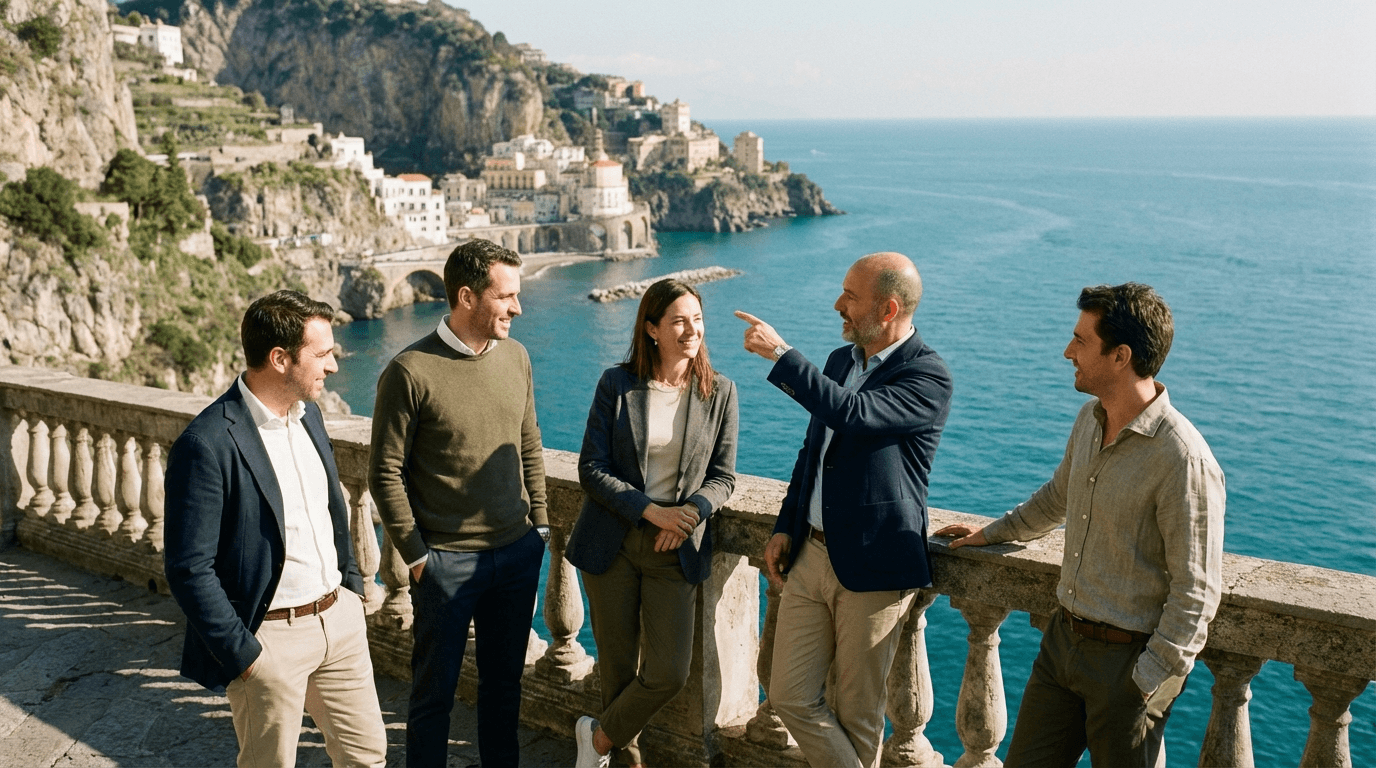
Long lunches are not indulgent. They are functional. Walking conversations through vineyards or along the Amalfi coast allow tension to surface without confrontation. Silence becomes productive.
The environment does not solve the problem, but it makes the work possible.
From mood to mechanism
The critical difference between a pleasant offsite and an effective one lies in mechanisms.
Outcome-driven retreats translate insight into structure. They create shared language, decision frameworks, and explicit agreements that survive re-entry into daily operations.
This is where many offsites stop short.
Teams articulate values, but not behaviors. They agree on priorities, but not trade-offs. They leave aligned in principle, but not in practice.
An executive offsite designed for outcome closes this gap.
It forces specificity. What does this decision mean on Monday? Who decides when priorities conflict? What behavior will change, and how will we notice?
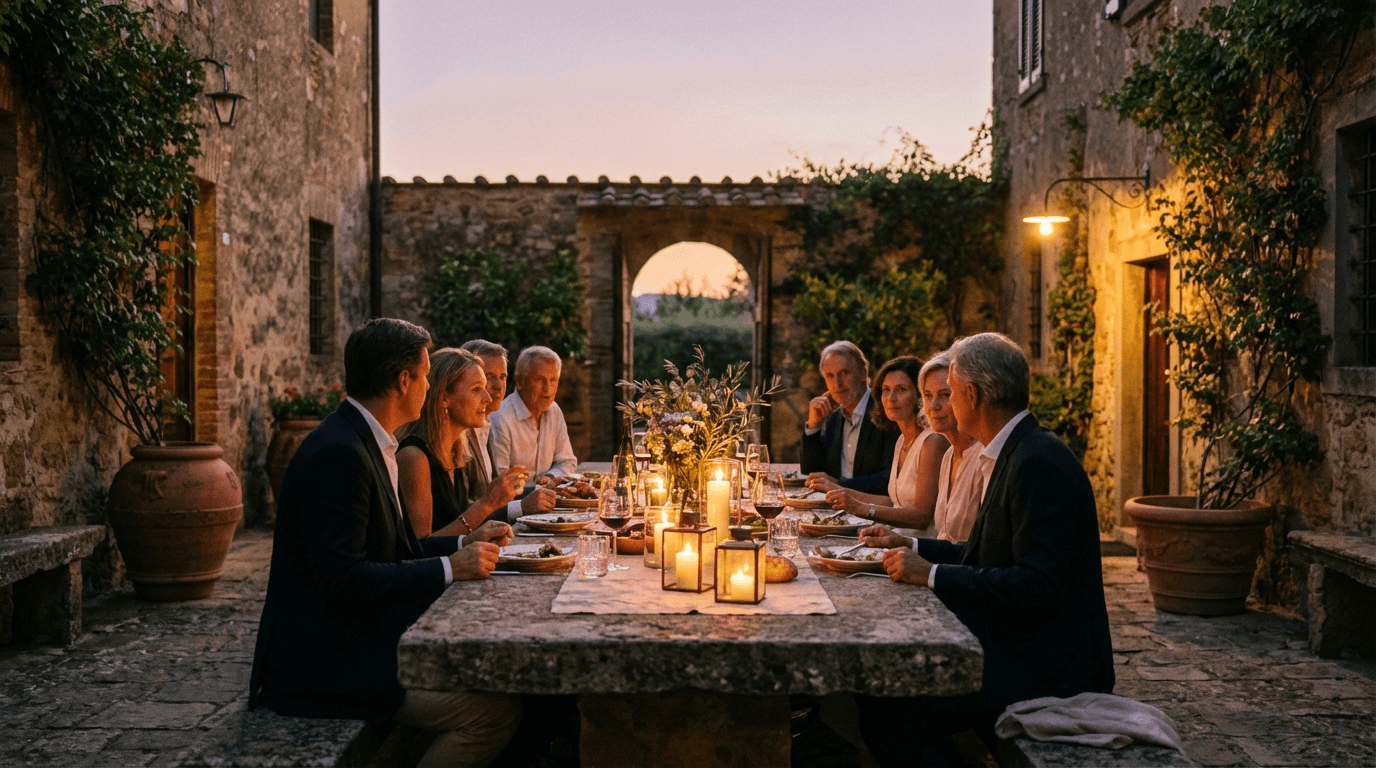
In Tuscany, this work often happens around a table that encourages focus, not spectacle. In Sicily, it may unfold through a sequence of structured conversations anchored in local rhythms. In Milan or Rome, it can take place in urban settings that mirror strategic complexity rather than escape from it.
Italy offers range, not a formula.
What this looks like in practice
Consider a leadership team scaling rapidly across markets.
They arrive in Italy not to celebrate growth, but to address friction. Roles have blurred. Decision speed has slowed. Trust has thinned under pressure.
The retreat does not begin with presentations.
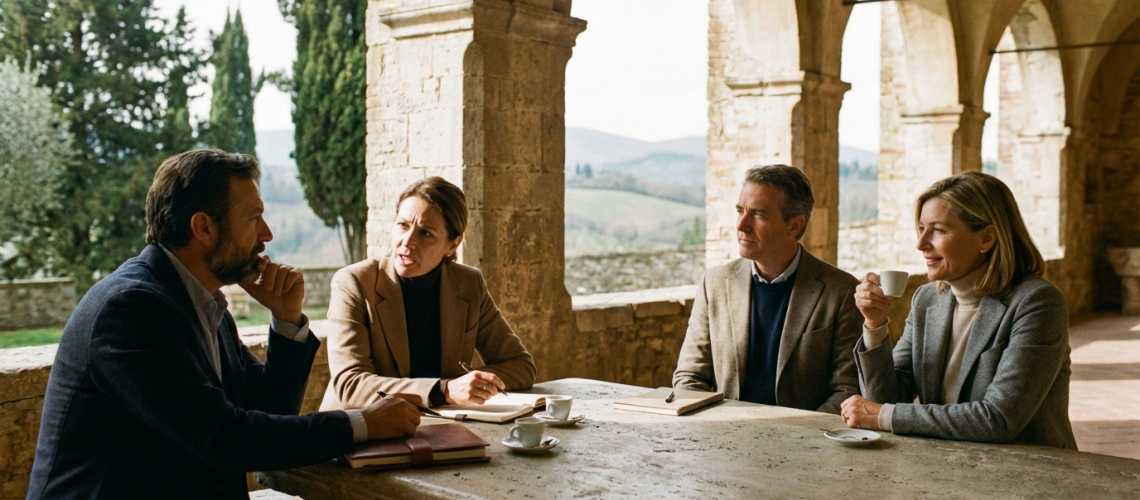
It begins with a shared diagnosis. Facilitated, structured, and uncomfortable in the right way. The location, perhaps a converted monastery in Umbria, provides quiet and separation without isolation.
Over several days, conversations move from symptoms to causes. Assumptions are tested. Power dynamics are named. Agreements are renegotiated.
Meals are not filler. They are intentionally placed to allow integration. Time is deliberately left open to let insights settle.
The retreat ends not with a summary slide, but with a small number of explicit commitments. Clear ownership. Clear consequences.
When the team returns, something has shifted, not because Italy inspired them, but because the work was done.
The value beyond the days themselves
For CEOs, the real question is not whether a retreat was enjoyable.
It is whether leadership behavior changes when pressure returns.
Outcome-driven executive offsites create value in ways that are difficult to quantify immediately, but easy to recognize over time. Faster decisions. Fewer misunderstandings. A leadership team that speaks with fewer words, because more is shared.
Italy contributes to this value by offering credibility and seriousness.
It signals that the time is protected. That the work matters. That this is not a reward, but an investment.
When designed well, the retreat becomes a reference point. A moment teams return to mentally when facing complexity.
Choosing the right partner
Designing an executive offsite at this level is not a logistical task.
It requires judgment. Experience. The ability to hold strategic tension without resolving it too quickly.
Partners who focus on destinations often optimize for beauty and activity. Partners who focus on outcomes optimize for clarity and impact.
This distinction matters.
End-to-end responsibility, from location selection to program design and facilitation, is not about convenience. It ensures coherence. Nothing is accidental. Everything serves the outcome.
Italy offers extraordinary raw material.
What determines success is how it is used.
A different way to think about your next offsite
If you’re planning an executive offsite in Italy, the most important question isn’t where you go, it’s what you want to change. The rest will follow.
A well-designed offsite does not answer every question. It clarifies the right ones. If you are reflecting on what would truly need to be different for your leadership team after stepping away, a thoughtful conversation is often the most natural place to begin.